

Most people do better with a set evening cue than with willpower alone. In this guide, I’d keep it simple: lower light 60 to 90 minutes before bed, move screens out of reach, add one nicotine-free, tobacco-free cue, and follow it with one or two quiet habits like tea, reading, stretching, or a short journal note.
Here’s the short version:
- Dim the room about 1 hour before bed
- Keep the room cool at about 65°F to 68°F
- Put your phone away and switch to audio or a physical book
- Use one repeatable cue like a nicotine-free botanical diffuser pen
- Follow with one screen-free habit for 5 to 30 minutes
- Repeat the same order each night so the routine feels automatic
I’d also keep the routine flexible in length without changing the order. A full version can take 60 minutes. A short version can take 20 to 30 minutes. Even a 5-minute reset still works if the cues stay the same.
If I wanted the fastest setup, I’d start with the room, add one aroma cue, and finish with a quiet habit I can do without a screen.
| Routine option | Time | Core steps | Best fit |
|---|---|---|---|
| Full routine | 60 minutes | Lights down → tea or aroma cue → stretch/journal → read | Standard weeknights |
| Short routine | 20–30 minutes | Lights down → aroma cue → breathing → one-line note | Busy evenings |
| Fast reset | 5 minutes | Phone away → lights down → warm drink or aroma cue | Very late nights |
That’s the core idea: make nighttime feel like a sequence, not a fight.
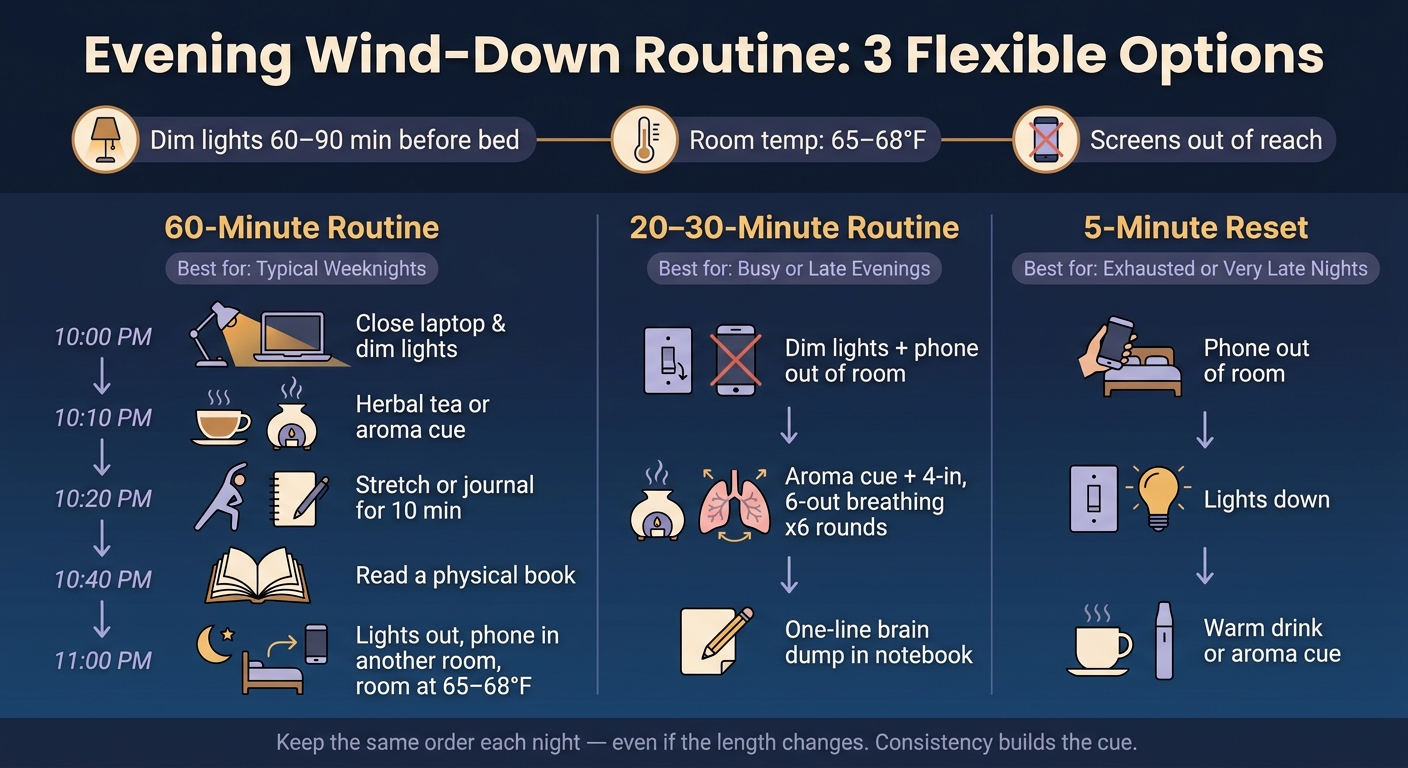
Evening Wind-Down Routine: 3 Flexible Options to Replace Nicotine & Alcohol
Set Up a Calmer Evening Space First
Before you add a new habit or product, make the room itself feel easier to settle into. That shift matters. Instead of leaning on the old cue – reaching for nicotine or alcohol – you’re giving your space the job of signaling that the day is done.
Adjust Light, Temperature, and Sound
About 60 minutes before bed, dim the lights. Warm lamps or low-watt bulbs send a simple message: night is starting.
Temperature plays a bigger role than many people think. Dr. Seema Khosla, a sleep medicine physician, says it best:
"The quicker your body temperature falls, the quicker you fall asleep."
For most people, the sweet spot is around 65°F to 68°F. If you can’t change the thermostat, use a fan or try cooling sheets. Even changing into loose, comfortable clothes can help. It gives your body a clear physical cue that your evening wind-down routine has started.
With sound, don’t aim for total silence. Steady background audio usually works better than random noise that pops up and pulls your attention. A white noise machine can cover uneven sounds without adding more stimulation. Soft instrumental music or nature soundscapes can do the same job.
Once the room feels calmer, add one repeatable cue that marks the move into nighttime.
Step Away From Screens Without Overcomplicating It
After the room is dimmer and quieter, deal with the last big source of stimulation: screens. The simplest move is also the one that works best for a lot of people. Put your phone out of reach. Charge it in the kitchen and use a basic alarm clock instead.
If you usually fall asleep with the TV on, don’t make it harder than it needs to be. Audio-only is a solid middle step. A podcast or audiobook gives your mind something to follow without the light and fast visuals from a screen.
A physical book works well too. Fiction is often the better pick over non-fiction since it’s less likely to pull you back into work mode. You can also set an alarm for 30 to 60 minutes before bed as a reminder to start winding down. That makes it easier to pair the moment with one simple cue, like a nicotine-free diffuser pen, as part of your adult daily routine.
sbb-itb-5292d78
Use Nicotine-Free Botanical Diffuser Pens as an Evening Cue
Once your room is dimmer and your phone is out of reach, a nicotine-free botanical diffuser pen can work as a simple cue that tells your brain the day is winding down. Honppo’s botanical diffuser pens are made for adults 21+ and are entirely nicotine-free and tobacco-free. The compact format uses no flame or ash, which makes it a clean sensory cue for an evening wind-down routine, not medical advice.
Honppo Nighttime Diffuser Pen Options

When the room starts to feel calmer, it helps to add one repeatable step that marks the shift into night mode. Honppo offers two nighttime pen options. Both are sold in single packs, and there is also a 3-pack bundle.
The Melatonin Nighttime Botanical Diffuser Pen has a lavender-forward blend with melatonin, chamomile, and lavender, making it a good fit for a regular nightly ritual. The Nighttime Botanical Diffuser Pen includes ashwagandha, chamomile, and eucalyptus, which may suit less frequent evening use. Follow the package directions and ingredient guidance.
How to Add a Diffuser Pen to Your Night Routine
Use it after one fixed cue, like changing clothes or dimming the lights. That small bit of consistency matters. It also pairs well with screen-free habits such as journaling or reading, so you can make it the first step once the lights go down.
Keep it brief and follow the package directions. Then move right into one quiet habit, such as tea, stretching, journaling, or reading. The idea is simple: use the pen as the start signal for your evening wind-down routine, then let the rest of the routine follow.
Comparison Table: Honppo Nighttime Diffuser Pen Formats
| Format | Pack Size | Price (USD) | Approx. Puffs | Key Ingredients | Best-Fit Use Case |
|---|---|---|---|---|---|
| Melatonin Nighttime Botanical Pen | 1-pack | $19.99 | 800–900 | Melatonin, Chamomile, Lavender | Regular nightly ritual |
| Nighttime Botanical Pen | 1-pack | $19.99 | 800–900 | Ashwagandha, Chamomile, Eucalyptus | Occasional evening use |
| Nighttime Bundle | 3-pack | $39.98 | 800–900 per pen | Varies by pen | Stocking up for consistent use |
Pick One or Two Screen-Free Habits to Add to Your Evening
Once the room is quiet and the diffuser pen has marked the shift, use the next 15 to 30 minutes for one calm, screen-free habit. You don’t need a packed routine. One or two simple choices are enough to help signal that the day is winding down.
Herbal Tea and Warm Drinks
A 6 to 8 fl oz mug of caffeine-free tea is an easy swap for late-night scrolling or one more episode. Chamomile and lavender are common caffeine-free picks for a calmer evening. Valerian is another option. Try drinking it 30 to 60 minutes before bed.
This works well as a small transition into reading, light stretching, or journaling. A warm drink can make that shift feel more intentional without adding much effort.
Gentle Stretching, Breathing, and Journaling
A 5- to 10-minute stretch session can help your body ease into a slower pace. Neck rolls, child’s pose, and legs-up-the-wall are all solid options for letting go of physical tension without getting yourself too energized. After that, do a few breathing rounds: inhale for 4 seconds and exhale for 6 seconds, repeated for six rounds.
Journaling fits nicely here too. Keep it short so it doesn’t start to feel like homework. You can write down tomorrow’s top three priorities or make a quick gratitude list. Three items is plenty. The main idea is to get tomorrow’s thoughts onto paper before bed. Stick with paper and pen so the habit stays screen-free.
Quiet Hobbies That Keep You Off a Screen
If you want the easiest option, go with a quiet hobby. Reading a physical book, working on a puzzle, knitting, or listening to acoustic music or a podcast can all fit into a 15- to 30-minute window.
Pick something low-stimulation and easy to stop when you’re ready for bed. That way, the habit supports your evening wind-down routine instead of pulling you back into a busy headspace.
Put It All Into a Simple Nightly Flow
Turn those habits into a set order you can repeat each night. Once the room feels calmer and your cue is in place, line everything up the same way. That’s what makes an evening wind-down routine stick: a few simple signals, repeated in the same order. Set up one full version for regular nights and one shorter backup for evenings when time is tight.
A 60-Minute Sample Routine for a Typical Weeknight
This version fits a standard weeknight when you have a full hour before your target bedtime.
- 10:00 p.m. – Close your laptop and dim the lights.
- 10:10 p.m. – Have chamomile or lavender tea, or use a Honppo Nighttime Botanical Diffuser Pen.
- 10:20 p.m. – Stretch or journal for 10 minutes.
- 10:40 p.m. – Read a physical book under a warm lamp.
- 11:00 p.m. – Lights out. Keep your phone in another room and the room around 65°F to 68°F.
A 20- to 30-Minute Routine for Busy Nights
For late nights or packed evenings, cut it down to three steps. Start by dimming the lights and moving your phone to another room. Those two signals do a lot of the heavy lifting. Next, use a Honppo Nighttime Botanical Diffuser Pen as your sensory anchor and spend 2 minutes doing 4-in, 6-out breathing. Then finish with a one-line brain dump: write down one thing that can wait until tomorrow, then close the notebook.
Comparison Table: Sample Wind-Down Routine Options
| Routine | Total Time | Activity Sequence | Tools Used | Best For |
|---|---|---|---|---|
| 60-Minute Routine | 60 min | Close laptop → Dim lights → Tea or diffuser pen → Stretch or journal → Read | Honppo Nighttime Botanical Diffuser Pen, herbal tea, journal, book | Typical weeknights, high-stress days |
| 20–30-Minute Routine | 20–30 min | Dim lights → Diffuser pen + 4-in, 6-out breathing → One-line brain dump | Honppo Nighttime Botanical Diffuser Pen, notebook | Late shifts, low-energy evenings |
| 5-Minute Reset | 5 min | Phone out of room → Lights down → One warm drink or aroma cue | Herbal tea or Honppo Nighttime Botanical Diffuser Pen | Exhausted nights, crisis nights |
You can mix and match based on your schedule. A tea-focused night, a diffuser-plus-journaling night, or a quick reset night still counts. The main thing is to pick the version that fits tonight, then do it again tomorrow as part of your evening wind-down routine.
FAQs
What if I only have 10 minutes before bed?
When you’ve only got 10 minutes, keep it simple. The goal is to use a few easy cues that tell your mind and body it’s time for an evening wind-down routine.
Dim the lights. Set your phone face down. Do a quick physical reset, like clearing off a counter or putting a few things back where they belong. It’s a small move, but it helps the room feel less busy.
Next, make a warm, non-alcoholic drink and add a calming scent with a candle, diffuser, or room spray. That can give the moment a more settled, end-of-day feel without turning it into a big production.
Finish with three slow breaths:
- Inhale for 4 seconds
- Exhale for 6 seconds
That’s it – short, repeatable, and easy to fold into an adult daily routine.
How long does it take for a new night routine to feel automatic?
Consistency matters most. The nervous system tends to learn through repetition and steady cues, so an evening wind-down routine can feel more natural and more automatic over time.
Results vary, but many people notice changes in their sleep and morning energy within 1 to 2 weeks. After about 3 weeks of sticking with the same routine, some also say they feel calmer and that mornings feel easier to handle.
Which screen-free habit is best if my mind races at night?
Journaling is one of the best screen-free habits for a racing mind. A few lines on paper can help clear mental clutter before bed. You might jot down what’s bothering you, make a next-day to-do list, or note one thing you got done today. That simple habit can quiet late-night overthinking.
Keep it simple. Write down tasks and next steps instead of trying to figure everything out at once. If journaling isn’t your thing, meditation or gentle stretching can also help ease tension and let your body settle for rest.